
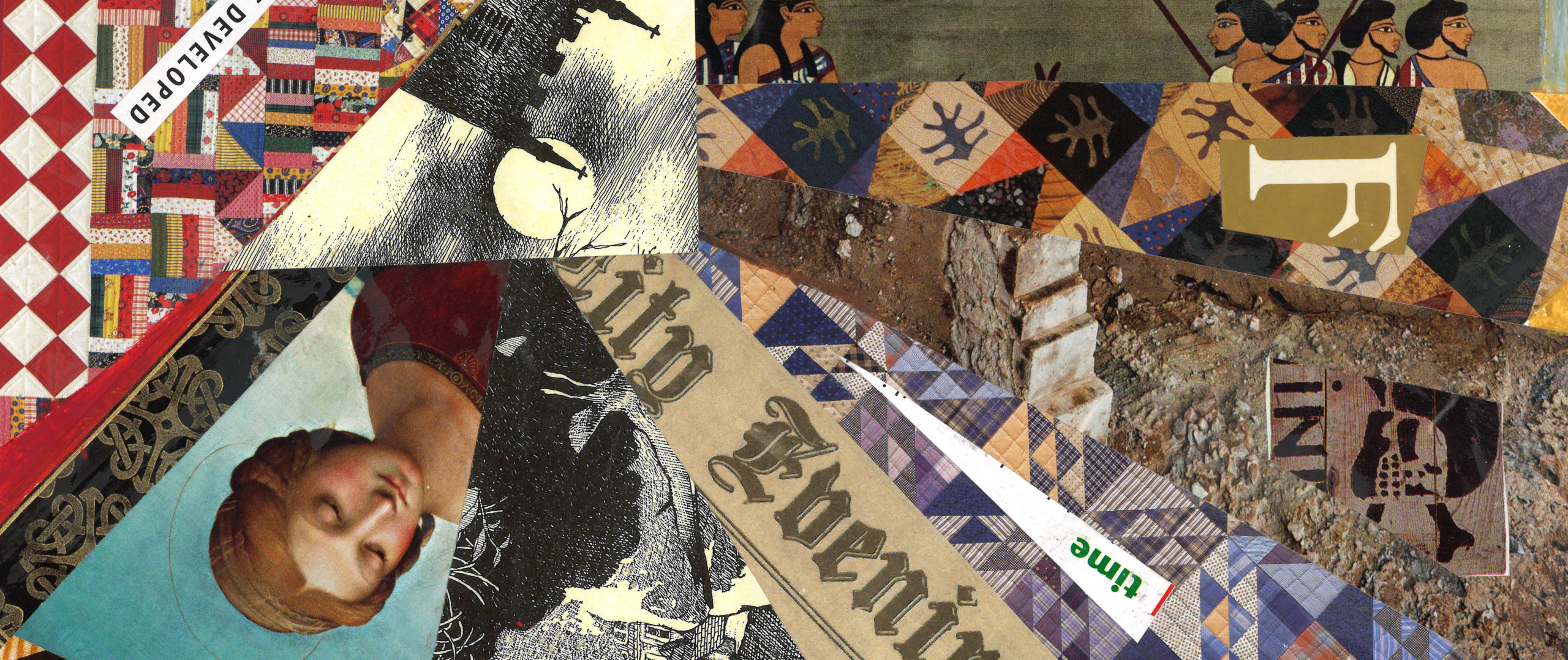
As your General Editor, one of my goals has been to elevate The Red Thread to a high visual standard. In publishing there are certain rules that must be followed to ensure readability, clarity, and a consistent, recognizable visual style. For us, however, this does not simply mean emulating the cleanliness of bourgeois magazines and newspapers. Much of what comes to mind when we think of corporate media stands in stark contrast to our politics: airbrushed celebrities, product placements, stock images, AI-generated text and artwork, et cetera. It’s easy enough to avoid these things in our magazine, but there are also some choices I’ve made in a deliberate effort to complement our political project.
The contemporary media landscape is littered with increasingly unreal simulacra. The news is barely news at all, only reporting the most simplified and sensational version of events. So many recent films are little more than a photocopy of an existing movie. AI-generated books and viral “bestsellers” have crowded many writers out of the publishing world. Social media is rife with ads, bots, trolls, AI “slop”, and algorithmic manipulations meant to make the user think and feel a certain way. Everything is either so sterile as to be utterly uninspiring or is targeted at base emotions: anger, fear, hunger, lust. There are few remaining places where we can encounter anything that truly feels meaningful and grounded in human experience.
Guy Debord explains this phenomenon as “both the result and the project of the present mode of production.” The elite extract as much material wealth as they can from the proletariat, and they must provide a spectacle in return that is more and more detached from the human experience, lest people start to notice what is happening. But it’s more complex than mere distraction. Capitalist media does sometimes acknowledge real problems, whether in the “evil billionaire” trope that so many onscreen villains fall into, in products labeled as “eco-friendly” or “ethically sourced”, or in the co-optation of revolutionary symbols and slogans to print on T-shirts, mugs, posters, and other cheap novelties. We are led to believe that we are engaging in revolutionary action by consuming these products, when in reality we are being funneled back towards the system, back towards dependence on capital and the owning class. The spectacle absorbs the aesthetics of radical politics in order to nullify them.
This is just as much the case with the resurgence of fascism in recent years. As Walter Benjamin puts it in “The Work of Art in the Age of Mechanical Reproduction”:
Fascism attempts to organize the newly created proletarian masses without affecting the property structure which the masses strive to eliminate. Fascism sees its salvation in giving these masses not their right, but instead a chance to express themselves. […] The logical result of Fascism is the introduction of aesthetics into political life.
No figure could exemplify this tendency better than our current president, whose obsession with appearances is unmatched. The catastrophe that was his recent attempt to paint the Reflecting Pool “American Flag Blue” and his futile insistence on blaming unidentified vandals for the resulting algae problem and peeling lining is only the latest in a long series of authoritarian farces. But no matter how laughable his behavior is, it serves a very distinct purpose. The fixation on the pool is not a simple diversion but an attempt to redefine what actually matters in politics. Symbols, flags, slogans, images—these are the things fascists and capitalists alike want people to care about more than material conditions and power dynamics.
All of this puts us in a difficult position as socialists. We are not just trying to challenge existing political and economic structures and promote our vision of a hopeful future, we are forced to do so in a media environment that is structurally opposed to our aims. We have to fight to prevent our message from being co-opted and ultimately drowned in the sea of “content” that everyone is floundering in. How is that remotely possible? How much can we trust the mechanisms of capitalist media outlets? How do we utilize aesthetics without merely becoming part of this grand spectacle? None of these questions have easy answers.
Throughout history, avant-garde art movements have broken through their society’s aesthetic veil to shine a spotlight on the tension between the average person’s real experiences and the unreal nonsense fed to them by the ruling class. Few of these movements were as controversial in their own time as Dada, which swept Europe in the years between the World Wars. It is difficult to pin down any specific definition of Dadaism, but it was broadly characterized by a desire to turn bourgeois aesthetic standards on their head. Artists who aligned themselves with it created everything from nonsense poetry to bizarre collage art, abstract paintings, and objects like Marcel Duchamp’s Fountain, a urinal displayed as a sculpture. Historian W. Scott Poole explains the movement thus: “None of it made sense because the world itself had ceased making sense.”
When the Nazis came to power, they violently suppressed Dada. Many artists were forced into exile and their art was either destroyed or put on display in “degenerate art” exhibits for the public to ridicule. Like today’s neoliberal spectacle, there were some things the Nazis absorbed from their enemies in order to take power from them, including the word “socialist” in the party’s name and some anti-capitalist rhetoric in their propaganda. But the emphasis they put on uniformity, presentation, and high cultural aesthetics required that they wipe out anything that contrasted too starkly. The goal was to fool the working class into believing that their symbolic gestures meant something, and that the media created by their leftist opponents represented a dangerous threat against German civilization.
There is a direct through-line from the right’s fixation on patriotic displays, classical art, and symbols of purity to the sterilized, algorithmic pastiche that dominates television, film screens, social media, and corporate magazines. In both cases there is a refusal to actually address underlying social problems and an effort to force the world into a particular aesthetic vision where nothing is controversial because all sources of tension and discord have either been suppressed or have simply become an integral part of the status quo. AI makes this easier than ever; it only takes a few keystrokes to flood the Internet with an abundance of images of how the right wants the world to look. When people are bombarded with images like this, they can not help but become alienated from reality.
The lesson we must learn from all of this is that aesthetics play a far more critical role in things than is often acknowledged. Symbols and images always come with political implications. While it is entirely possible to enjoy a work of art, a film, a book, a meme, or some other piece of media separate from its role in the grander scheme of social and economic relations, it is vital that we make ourselves aware of those relations and think critically about how they influence even the banal. The point here is not to lecture anybody about whatever they might like to consume, but simply to state that being ignorant of how spectacle is used against us hinders our cause severely.
Dada is no less prone to co-optation than any form of art today. Capital seems to absorb avant-garde aesthetics more quickly than ever before, and fascists have proven adept at exploiting things like meme culture (which itself has been described by some critics as a contemporary form of Dada) to benefit their cause. But by emulating some of its aesthetics, namely through the collage art that has been a motif in recent editions of this magazine, it has been my hope to signify what our role is here. Like in 1920s Germany, the disparity between the spectacle we are shown and what we actually experience makes it increasingly difficult to make sense of the world today. Reflecting that senselessness in visual ways points to our desire to combat it. I have tried to signify our aims through other elements as well: textured backgrounds, torn edges, hand-drawn artwork, and even the simple choice to print pages on uncoated paper. These things, in my view, offer The Red Thread a physicality that complements our materialist politics and that rejects the cleaner but far more manipulative aesthetics employed by our opponents.
Aesthetics alone do not make a successful socialist movement, and I am under no impression that imitating the style of a bygone era’s radical art is going to supercharge our efforts to build class consciousness. Regardless, there is intentionality here. The Red Thread is not meant to be just another magazine or newsletter. It is a document of our history, our theory, our motivation and intentions. As such, it is my desire for it to be extremely self-aware, to know where it stands in the long line of socialist movements and in the even longer history of human art and literature. While corporate media and fascist propaganda deliberately make it difficult for anyone to string together coherent thoughts about history, politics, and other matters, it is our duty to stand out and to provide some degree of lucidity. Every connection we can make with the past and with the reality that our demands are rooted in makes a difference. It helps to make us self-aware. And in a world that is dominated by spectacle, nothing is more valuable than the moments when we are able to confront both ourselves and our situation in an authentic and grounded way.
To Read More Member Stories From Our Chapter, Purchase Your Own Copy Of The Red Thread.